How much does forestry mulching cost per acre in Tennessee?
Published 2026 cost data puts forestry mulching in Tennessee at roughly $1,105 to $1,950 per acre on average growth. National cost guides spread wider than that, from about $400 to $800 an acre on light brush up to $3,000 to $6,000 an acre in heavy timber.
Those are market figures, not our price list. If you are budgeting for forestry mulching in Chattanooga or anywhere around Chattanooga, the ranges below will get you close enough to plan around.
One more number worth knowing. A Chattanooga area contractor publishes $150 to $300 per hour, or $2,500 to $5,000 per acre, on its own website. That sits at the high end of what gets printed for this part of Tennessee, and it shows how wide the real spread runs.
What do the published ranges look like?
Cost guides sort mulching by how thick the growth is, because thickness is what sets the price. Here is where the 2026 numbers land.
| Ground condition | Typical published range per acre |
|---|---|
| National average, average density | $400 to $800 |
| Light brush, grass, saplings under 3 inches | $500 to $2,000 |
| Tennessee, average growth | $1,105 to $1,950 |
| Southeast region, all densities | $1,200 to $3,500 |
| Medium growth, thick brush, trees under 6 inches | $1,500 to $3,500 |
| Chattanooga area, contractor published | $2,500 to $5,000 |
| Heavy growth, large trees, dense vines | $3,000 to $6,000 |
| Mature hardwood, closed canopy | $4,000 to $8,000 and up |
Sources: HomeGuide, HomeAdvisor, LawnStarter, the OWNR OPS national and Tennessee cost guides, and a Chattanooga area operator’s published pricing.
Two things stand out. The rows overlap, and every single range is wide. That happens because the guides average jobs from every state and every kind of ground. A flat acre of privet feeds through fast. A wooded acre on a ridge side does not.
The Southeast row is the useful one for planning. That same guide calls the Southeast the most competitive market in the country for mulching, which tracks with what gets quoted around here.
What drives the cost of forestry mulching?
A handful of things move the number more than anything else.
How thick the growth is. Stems per acre matter more than the acre count. Published operator benchmarks put light brush at 3 to 5 hours an acre, and dense brush with 6 to 12 inch trunks at 8 to 12 hours or more.
How big the trunks are. Pencil-thick privet feeds through a mulcher head quickly. Trunks near the machine’s ceiling slow everything down, and the price follows the hours.
The ground itself. Slope, rock, and soft spots all cut production. The Tennessee cost guide names Appalachian terrain and rocky soil as state cost drivers. That matches the ground here, with Walden’s Ridge running right up the west side of Soddy-Daisy. Ridge side lots cost more to mulch than flat valley ground.
How wet it is. The Chattanooga area gets 50 or more inches of rain a year, and the red clay holds it. A machine on soft ground works slower and tears up more turf, so most quotes carry that risk in them.
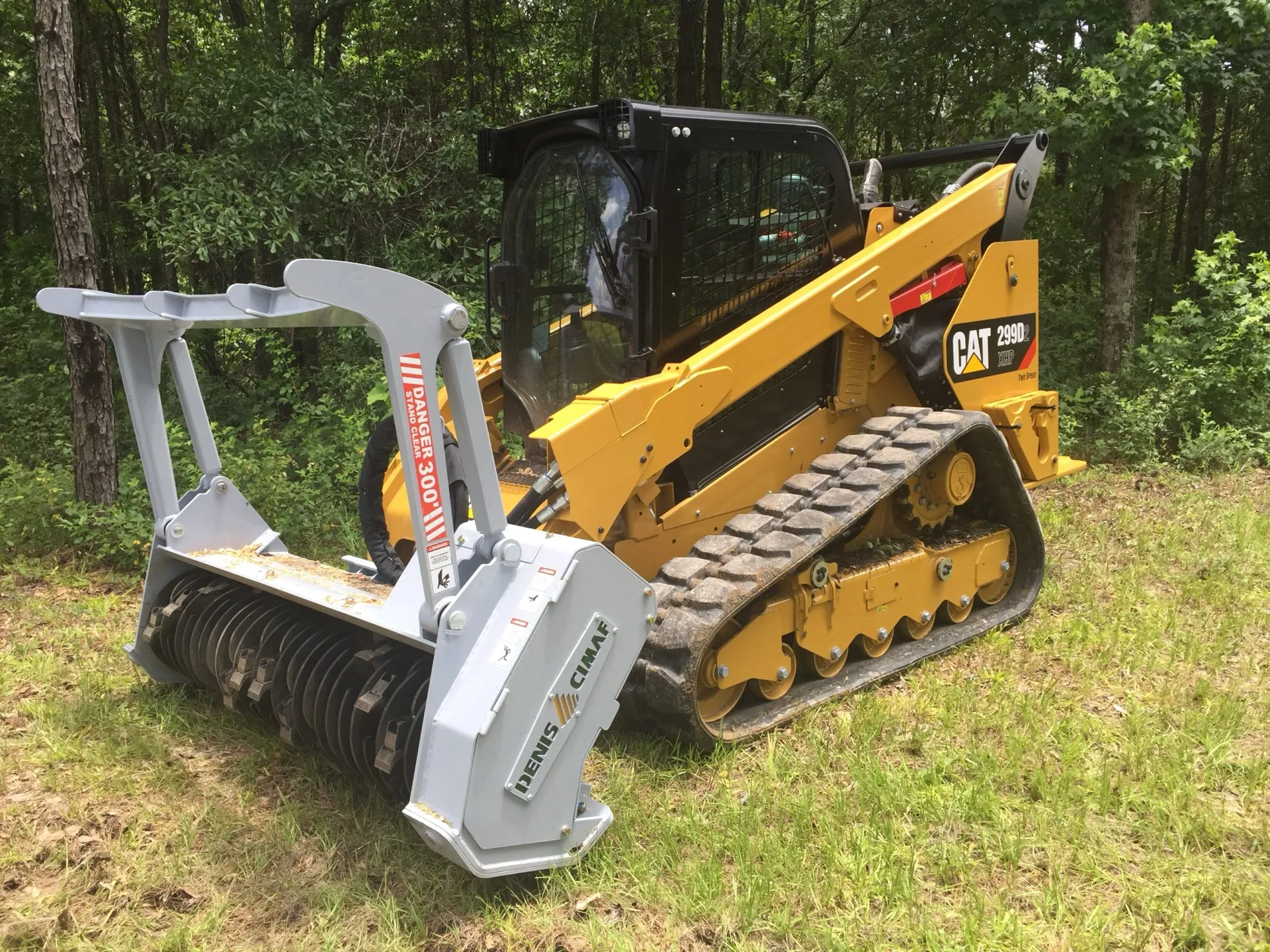
Access. A long carry from the road, a locked gate, or a narrow side yard all add hours. Our mini skid steer fits through a standard fence gate, which keeps back yards and tight lots in reach without taking a fence apart.
How clean a finish you want. One pass knocks growth down to a rough floor. A second pass grinds the mulch finer and leaves something closer to mow-ready. Every extra pass is more machine time on the bill.
Is mulching priced per acre, per hour, or per day?
All three get quoted, and underneath they are the same number wearing different clothes. What a contractor actually sells is machine time.
National guides put a mulcher with an operator at $125 to $300 per hour, or $1,000 to $2,500 per day. The Tennessee cost guide runs higher on the day rate, at $2,600 to $4,000, with labor, fuel, and insurance built in. One Tennessee land clearing company publishes a flat $2,800 per day for a skid steer mulcher.
Divide a day rate by acres covered and you have the per-acre price. Published production for a skid steer mulcher is 1 to 3 acres a day. That single fact explains most of the spread you see in quotes. Same machine, same daily cost, very different acres covered.
Per-hour pricing suits small or unpredictable jobs, where nobody can tell from the road how thick it gets in the middle. Per-acre suits open ground with even growth. Cost guides also note a mobilization fee of $150 to $300 on a lot of jobs, since loading, hauling, and unloading a machine burns real time before the first stem drops. That is why a quarter acre never costs a quarter of the acre price.
Project totals get quoted too. An East Tennessee operator publishes $1,500 to $3,500 for a quarter acre to an acre, and $3,500 to $10,000 for one to five acres.
How does mulching compare with traditional land clearing?
Traditional clearing cuts, pushes, piles, and then removes. Every one of those steps carries its own cost. Published figures put traditional clearing at $2,000 to $6,000 an acre, plus $500 to $2,000 or more to haul the debris away, plus $150 to $500 per stump when the stumps come out.
Mulching does the work in one pass and leaves the material where it falls. National cost guides put the savings at 20 to 40 percent overall. Tennessee numbers say the same thing: the state guide shows land clearing at $1,300 to $4,500 an acre against $1,105 to $1,950 for mulching on comparable ground.
The saving comes from steps that mulching skips. The brush stays on site as chips, so there is nothing to burn and nothing to load out. Grubbing stumps across a whole lot is where the Tennessee figures jump hardest, to $2,600 to $4,160 an acre.
What size trees can a forestry mulcher handle?
Mulcher heads have a real ceiling, and it is lower than most people expect. Equipment makers and cost guides put a skid steer mulcher at trees up to about 6 to 8 inches across. Heavy duty heads reach 10 to 12 inches in good conditions. The large purpose-built forestry machines go to 12 to 15 inches.
A drum mulcher does its best work where stems stay under roughly 6 inches. That covers most grown-up fence lines, fields, and lot edges across Southeast Tennessee and Northwest Georgia. Larger hardwoods on a property are a separate conversation, and we look at those on site before quoting anything.
When is forestry mulching the wrong tool?
Mulching grinds growth down to a chip layer at or near grade. The root systems stay in the ground. That suits most of what people want it for, and it causes trouble for a few things.
If the ground has to be dug or built on, mulched ground is not ready for it. The stumps and roots are still down there. That is dirt work, and it is a different job with different equipment.
If a few stumps are the whole problem, a mulcher is more machine than the job needs. Grinding those out on their own comes in cheaper.
If the growth is soft field overgrowth and the goal is knocking it back, a rotary cutter runs cheaper than a mulcher head. That is what brush clearing handles, and it is the better call on pasture and open fields you plan to keep mowed anyway.
And if a property carries merchantable timber, mulching grinds up wood that could have been sold instead. Worth checking before any machine runs.
Getting a real number on your property
Most jobs around here are not textbook acres. They are the back half of a lot gone to privet, or two acres of a five acre parcel that got away from somebody over a few summers.
Before you call anyone, note four things: how thick the growth is, how big the biggest trunks run, whether a machine can get in, and how much of the property you actually want opened. Those four answers make up most of any quote. A photo or two texted over helps size the job before we drive out.
We are based just north of Chattanooga and cover the whole Chattanooga area, Southeast Tennessee, and Northwest Georgia. Veteran owned, family run, licensed and insured.
For a number that fits your ground instead of a national average, we come look at it and price the forestry mulching work off what is actually growing there. The estimate is free. Call or text (423) 260-5675.
Sources used for the ranges above: HomeGuide, HomeAdvisor, LawnStarter, the OWNR OPS forestry mulching and Tennessee land clearing cost guides, Skid Pro equipment specifications, and published rates from Tennessee and Chattanooga area land clearing contractors.